Thursday, September 27, 2018

Salzburg

A day trip to Salzburg (Austria) was an optional excursion on our Danube river cruise. We elected this option because Salzburg was high on our list of places to see and we are glad we made that decision. The downside of selecting the day trip to Salzburg was that we had very little time in Linz, but one of the positives beyond Salzburg itself was that we got to at least briefly experience Mondsee on the way to Salzburg. Even though we spent far more time in Salzburg than we did in Linz or Mondsee, we were still only able to experience a small fraction of what Salzburg ("salt castle" / "Festival City") offers.

Salzburg is located on the Salzach River. This river is a tributary river to the Inn River and so its waters eventually become part of the Danube River (at Passau, Germany).

We started our tour of Salzburg on the New Town side of the Salzach in the Mirabell Gardens (gardens of Mirabell Palace [Schloss Mirabell]).

The Pegasus Fountain seemed to be one of the more popular spots in the Mirabell Gardens.

We used the Makartsteg Bridge to cross the Salzach River to the Old Town side of Salzburg. That bridge had numerous padlocks on it and these are discussed in online resources such as "Love Lock Pedestrian Bridge" and "Salzburg Bridge Attracts Lovers and Locks."

The Old Town portion of Salzburg was what I had pictured in my mind when I thought of Salzburg based on "The Sound of Music" and other sources of information on Salzburg that I had previously encountered. The Getreidegasse is described as "the bustling heart of Salzburg’s Old City."

Wolfgang Amadeus Mozart was born at No. 9 Getreidegasse in 1756 in "Hagenauer Haus."

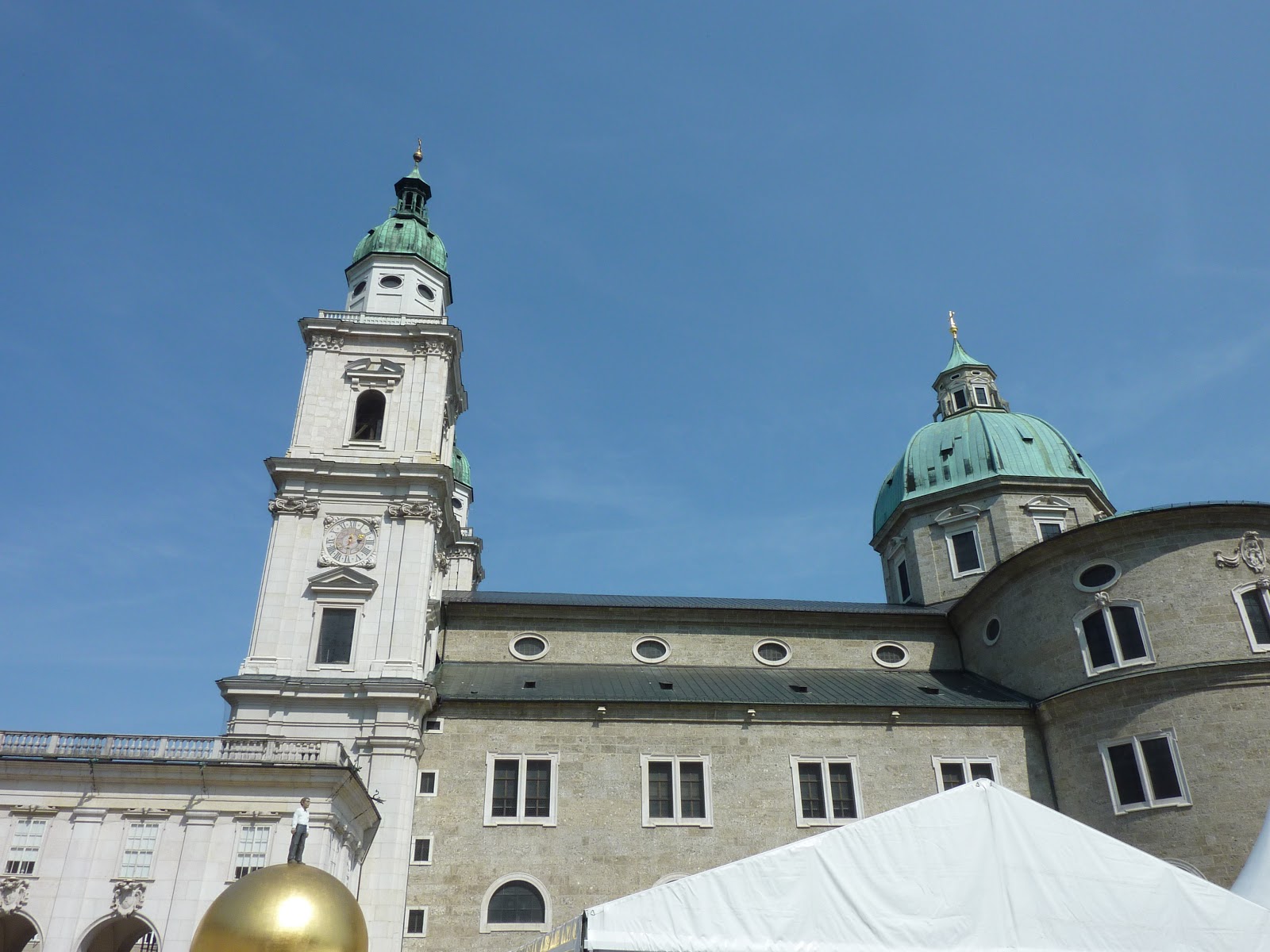
I was not able to get good photographs of Salzburg Cathedral (Dom zu Salzburg) because of work being done in front of it.

St. Peter's Monastery and Cemetery were popular with the tourists. It's no wonder given that St. Peter's Cemetery has been called "one of the most beautiful cemeteries in the world" and given the late scene in "The Sound of Music" that was inspired by this cemetery.

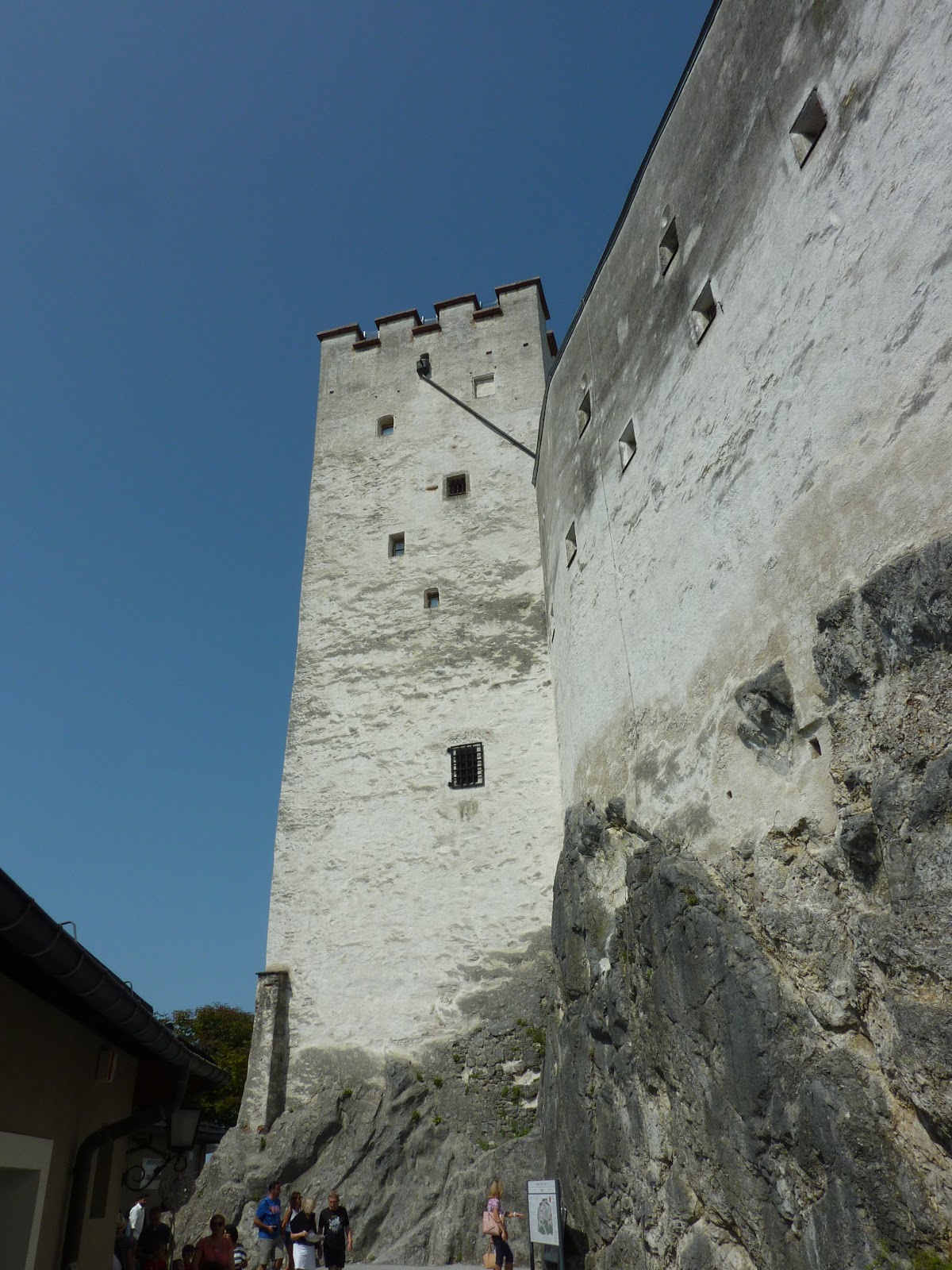
We have found in our first trip to Europe (and in other trips) that some of the best photographs and memories of a city can be captured from high vantage points. This was the case in Salzburg, where we took photographs from Hohensalzburg Fortress (Festung Hohensalzburg).

The easiest approach to the sprawling Hohensalzburg Fortress is via FestungsBahn, a furnicular that takes less than one minute to go from Salzburg up to Hohensalzburg Fortress.

Hohensalzburg Fortress is huge. I only show a single photograph here, but more can be found at this Hohensalzburg Fortress Pictures and Videos site.

Although Hohensalzburg Fortress and the Fortress Museum are interesting to see in its own right, the views from it are even more spectacular.

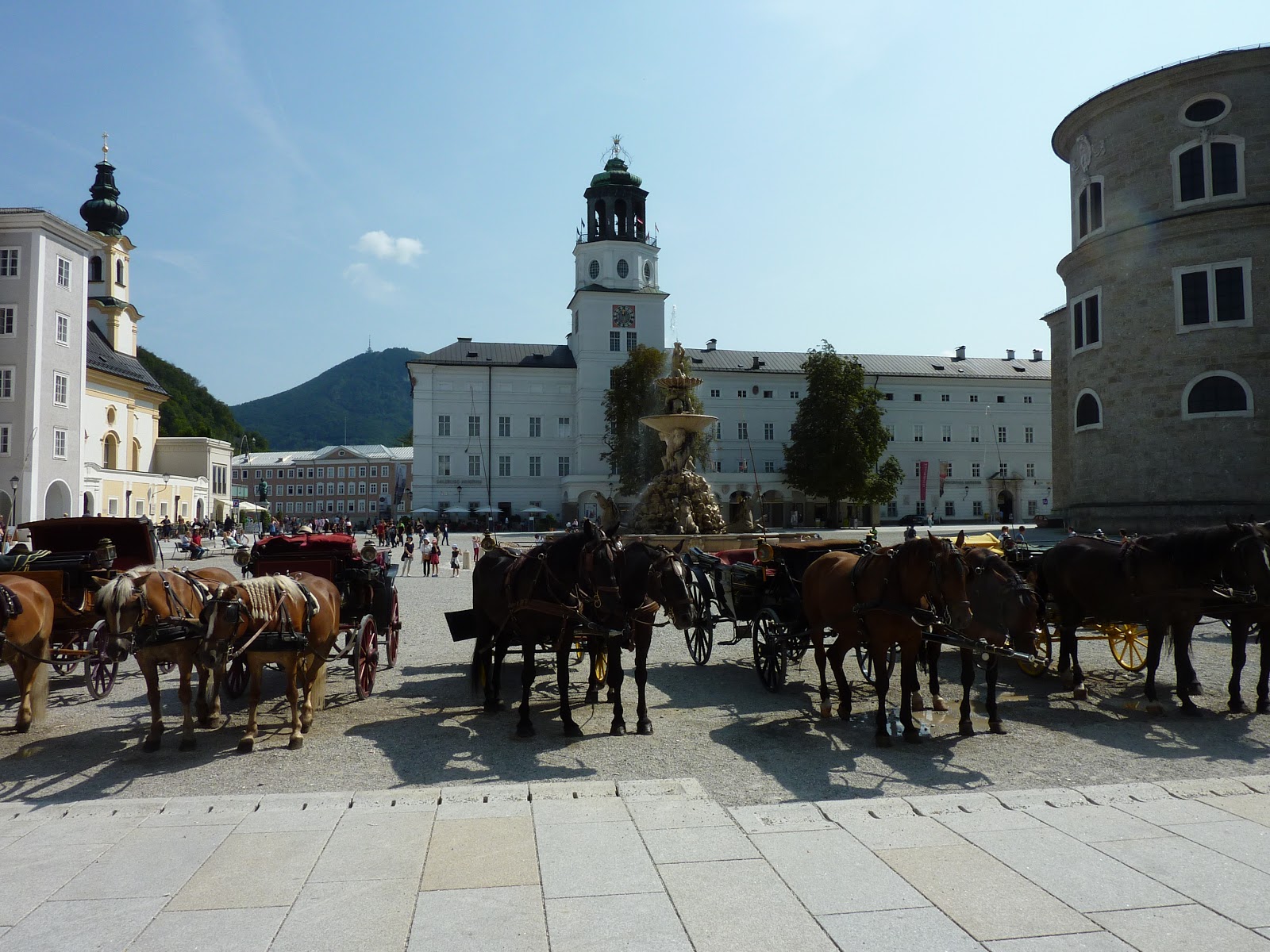
Residence Square (Residenzplatz Square) and its Residence Fountain (Residenzbrunnen) attract many photograph-taking tourists!
While at Residence Square, we visited the Panorama Museum. That museum's page describes the 360 degrees panoramic painting that visitors can view from a platform, "As far as the eye can see: the cycloramic painting by Johann Michael Sattler gives us a view onto the City of Salzburg and its environs around the year 1829." The platform within the 360 degrees and highly detailed panoramic painting is the centerpiece and highlight of the museum, but it also has photographs, drawings, and text describing Salzburg's history (particularly fires and rebuilding). See the TravelAdvisor reviews to get a good idea of what to expect and not expect from this museum.

Before leaving Salzburg, we visited a few of its shops and sampled the "Original Salzburger Mozartkugel."

I purchased small books with photographs and light descriptive text of most cities we visited on this trip. For Salzburg, I purchased a copy of Colorama's 14th Edition (July 2016) of Salzburg: The Festival City set amidst a Gorgeous Alpine Countryside." This book features a section "Surrounding Areas of Salzburg" ("Day Trips to Surrounding Areas") that includes some photographs that make me wish we had time to visit those areas outside of Salzburg. These areas include Kehlsteinhaus (The Eagle's Nest), the Salzkammergut, Giant Ice Caves in Werfen, Liechtensteinklamm, Hohenwerfen Fortress, and Hohe Tauern National Park.

When we were reserving and planning this trip, we had high hopes for Salzburg and it was definitely worth the bus ride to see it and spend time in Salzburg. I just wish we had more time to see a few more things in Salzburg and in its surrounding area (including Mondsee).

Mondsee

I normally would not dedicate a blog post to a town or lake that we barely spent any time in, but viewing Mondsee Lake (Austria) was my first experience in Austria where I appreciated, "I'm in Austria!" On our first day in Austria, we had only seen the side of Linz that is routine for any city, but we would get to enjoy Linz's more beautiful portions that evening.

We only got to see Mondsee (Moon Lake) on this river cruise trip because we had elected to participate in the day trip excursion to Salzburg (Austria). Our tour bus, like many other tour buses, stopped at the Landzeit Mondsee along the route from Linz to Salzburg that looks over Mondsee. One of the practical reasons for stopping there was to make use of the large public facilities area before entering Salzburg. This particular set of restrooms had a machine with an attendant that accepted Euro coins to use the facilities.

The photographs in this post were taken from that Landzeit Mondsee location.

The blog post "Mondsee Austria – A Delightful Lakeside Town" describes many of the things we missed by only making a "pit stop" in Mondsee and then driving by it on the way back to Linz from Salburg. We were able to view the Basilica St. Michael (Wredeplatz, Mondsee) from the highway as we rode back to Linz from Salzburg. We were not able to stop and spend time inside, however, and it's the inside of this building that is most famous because the interior was featured in the 1965 movie "The Sound of Music."

Because most of our day in which our river cruise ship was docked in Linz was spent in Salzburg, we did not get much time in Linz or Mondsee. I'd welcome the opportunity to return to this part of Austria in the future and spend more time in all three areas (Mondsee, Linz, and Salzburg).

Wednesday, September 26, 2018

Linz

We spent most of the day that our cruise ship was docked in Linz (Austria) on an excursion in Salzburg (Austria) and so did not get to see much of Linz. Although it was great to experience Salzburg, I was sorry we didn't get more time in Linz.

My initial impressions of Linz were not great because about all we could see from the cruise ship on the river was a graffiti-covered concrete wall. On the bus trip out of Linz heading to Salzburg, we mostly saw an industrial/business side of the city. However, on the bus ride back from Salzburg, the bus driver and tour guide intentionally took us back to the cruise ship via a route that went through the Old Town area and the Main Square (Hauptplatz). The photograph above and the next two photographs (which both feature the Trinity Column) are of that Main Square.

Although our river cruise ship's chef and his staff did a great job preparing meals for us to enjoy on the cruise ship, we decided to skip dinner on the ship on this night to allow us to spend a few hours in Linz after our day excursion to Salzburg. We were glad we made this decision as it allowed us to enjoy dinner sitting outside in the Linz Main Square's Restaurant El Greco in the early evening hours and then to enjoy the beauty of that square and Linz's position on the Danube at night.

The post "15 Best Things to Do in Linz (Austria)" begins with this sentence, "Linz is a beautiful and sometimes underrated city located in the northern part of Austria on the River Danube." I definitely agree with both the assessment of its beauty and its being underrated. Also, seeing that list of "15 best things to do in Linz" and the similar post "12 Top Tourist Attractions in Linz & Easy Day Trips" reinforces my feeling that I'd like to get back to Linz to more properly enjoy what the city has to offer.

Tuesday, September 25, 2018

Regensburg

We were able to visit Regensburg (Germany) for approximately half a day on our recent Danube River cruise. This wasn't nearly enough time to see all of the interesting-looking sites, but we did get a decent introduction to the city. Regensburg features historically significant structures as evidenced by its being named to the UNESCO World Heritage List. Regensburg is another city by three rivers (Danube River and its two tributary rivers Naab and Regen). It is the Regen River, of course, that lends its name to Regensburg.

For me, one of the most memorable sights in Regensburg is its Stone Bridge (Steinerne Brücke).

The views from the Stone Bridge perhaps surpass even the views of that bridge.

It's amazing to think that the Old Stone Bridge was constructed in the 12th century. Relative to that, the Bruckmandl is relatively young, having been erected in the 16th century.

The other landmark of Regensburg that can be used to quickly identify it (and to figure out where one is when in and around the city) is the Gothic Cathedral of St. Peter (Regensburg Cathedral). Sacred Destinations describes this as "the finest Gothic building in Bavaria."

We spent some time in the sizable market area of Old Town and sampled some of the local snacks and desserts.

Although we saw and were able to spend significant time at the Old Stone Bridge, at St. Peter's Cathedral, and in Old Town, a half day in Regensburg did not afford us nearly enough time to see all of the interesting-looking attractions in that city.

Passau

Before planning this first trip for us to Europe, I had never heard of Passau (Germany), but it turned out to be a very nice surprise when we visited it on our Danube river cruise. We only got to spend half a day there and I would have liked more time in this beautiful and charming city.

Passau is sometimes referred to as Dreiflüssestadt ("City of Three Rivers") or "Three Rivers City" because of its location on the Danube (Donau) River where tributary rivers Inn (shown in next two photographs) and Ilz join the Danube River.

This location by three rivers contributes to the beauty of Passau, but it also has been cause of severe flooding throughout Passau's history. The markings on the Old Town Hall (Altes Rathaus) indicate the peak level of each flood over the years can be seen in the bottom right corner of the next photograph (2013 was one of the highest!).

Doug Nield took the next photograph that shows the flood level markings close up.

One of the most impressive sights as one sails into Passau is the fortress known as Veste Oberhaus.

Beyond the things to see in Veste Oberhaus itself, the walk up to it is worthwhile for the views of Passau alone. These photographs provide a small taste of the visual appeal of Passau from that vantage point.

For someone who had never visited Europe before, Passau met many of my expectations of what an older (compared to most cities in the United States) European "old town" would be like (cobblestone streets, fountains, statues, dramatic cathedrals, etc.).

The Wittelsbacher Fountain is part of Residenzplatz ("Residence Square") in Passau. Two of Saint Stephen's Cathedral's three green domes can also be seen in this photograph.

The baroque St. Stephen's Cathedral (Dom St. Stephan) is one of the most obvious landmarks in Passau from near or far.

The Cathedral of St. Stephen features short organ concerts that demonstrate one of the world's largest organs. I wish we had more time so that we could have listened to one, but with only half of a day in Passau, we chose to ascend the hill to Veste Oberhaus in our free time instead.

Passau at night is gorgeous, but my simple camera cannot adequately convey that.

We really enjoyed visiting Passau and were sorry to have to leave so soon. There definitely was much more there to see than we were able to see in half of a day.

Monday, September 24, 2018

Vilshofen an der Donau

Vilshofen, Germany, was the Danube River port town from which we embarked on our Gate 1 Travel river cruise on the Monarch Empress.

Donau is another name for the Danube River and Vilshofen is referenced as "Vilshofen an der Donau" based on its location, which is described on the International Trading Company's web page as, "located in the southern part of the Bavarian Forest and on the banks of the Danube."

That same web page states that "three creeks - the Vils, the Pfudrach and the Wolfach - add here more water to the mighty [Danube] river."

Vilshofen was one of the smaller towns we saw on our river cruise and seems to have been the smallest in which we were docked in its port. However, we were happy to have the opportunity to spend several hours here before starting the river cruise. It was a great town to kick off our first trip to Europe.

Narrow cobblestone streets would be experienced frequently through the course of this trip, but we don't see them as much here in the United States except for certain areas such as in Boston. We really enjoyed strolling through the Stadplatz section of Vilshofen (with the historic town tower) and along the riverbanks.

We ended up having lunch on the street shown above (it seemed to have the restaurant options). We had been told that nearly all European restaurants accept credit cards, but all three proprietors we talked to in Vilshofen only accept cash. We had a small amount of local currency (Euros), but decided to play it safe and withdrew additional Euros from an ATM at a bank located on this street. We ate lunch at Burger Brothers & More because they had really nice outdoor seating available, because the items on the menu photographs looked good, and because the menus included English titles above several of the German food item descriptions.

Vilshofen provided us with a nice, relatively quiet introduction of the types of things we'd see on this trip. I didn't really "feel like I was really in Europe" until we visited Vilshofen. I'm very happy now that I selected it as the embarkation point for our cruise, a decision I made without really knowing what I was doing at the time.

Our First Trip to Europe

For 11 days spanning late August through early September of this year, we participated in a Gate 1 Travel Danube River Cruise that included two nights in the Hilton Budapest City hotel. We docked at least briefly at ports in Vilshofen (Germany), Passau (Germany), Linz (Austria), Melk (Austria), Vienna (Austria), Bratislava (Slovakia), and Budapest (Hungary). In addition to those port cities in which the Gate 1 Monarch Empress docked, we also visited Regensburg (Germany), Salzburg (Austria), and Szentendre (Hungary). Although we flew into Munich (Germany) and departed from Frankfurt (Germany), we didn't spend enough time in either city outside of their airports to make any useful observations.

The Danube River (Donau) is the second longest river in Europe, runs through ten countries including Germany (where it starts), and empties into the Black Sea (Romania and Bulgaria). Our river cruise started in Vilshofen, Germany, and ended in Budapest, Hungary, moving mostly west-to-east and passing through 4 of the 10 countries the Danube touches. The Danube River flows through more countries than any other river on Earth.

I plan to briefly review highlights of some of the European cities we visited as part of this trip in a series of blog posts. Links to those posts will be added to this post as each is written. The first two links shown below are to general observations and tips regarding European travel from the western hemisphere.